


In the field of contemporary architecture, weathering steel (Corten steel) has evolved from a niche industrial material into the material of choice for high-end building envelopes. Its appeal lies in its “living” surface—a rich, ever-evolving patina that mirrors the textures found in nature. However, the term “maintenance-free” is often misused in marketing brochures. For architects, developers, and building owners, understanding the nuances of weathering steel maintenance will determine whether a building will gracefully endure for a century or suffer premature structural failure.
Although Corten steel is indeed exceptionally resilient, its longevity is no accident but rather the result of proper environmental management. This guide delves into every aspect of Corten steel facade maintenance, offering not only surface-level recommendations but also a deep technical analysis of the underlying principles governing the interaction between this extraordinary alloy and its surroundings.
Although Corten steel is indeed exceptionally resilient, its longevity is no accident but rather the result of proper environmental management. This guide delves into every aspect of Corten steel facade maintenance, offering not only surface-level recommendations but also a deep technical analysis of the underlying principles governing the interaction between this extraordinary alloy and its surroundings.
1. Short Answer: Minimal, Not Zero
The most straightforward answer to the question of maintenance is this: Compared to nearly all other exterior cladding materials, weathering steel requires significantly less maintenance; however, it is not a truly “set-and-forget” product. By “minimal,” we mean that it does not require traditional, physically demanding tasks such as sanding, priming, or repainting. However, weathering steel is a reactive material. It “breathes” and reacts to its surroundings. Therefore, maintenance is less a physical labor and more a form of stewardship—ensuring that, throughout its entire lifecycle, the conditions necessary for the steel to protect itself remain optimal.
Patina = Built-in Protection (No Painting!)
The fundamental reason Corten cladding requires no paint lies in its metallic composition. When ordinary carbon steel rusts, it forms a rough, porous, and flaky rust layer. This “active” rust layer allows oxygen and moisture to continuously penetrate the metal, eventually leading to complete oxidation (structural failure). However, Corten steel contains specific proportions of copper, chromium, and nickel. When exposed to the natural environment, these alloying elements promote the formation of a dense, amorphous, and tightly adherent oxide layer, known as “patina.”
This patina acts as a physical barrier, effectively “sealing” the underlying steel and preventing further atmospheric corrosion. Since this protective layer is an intrinsic part of the metal structure, it will not peel, flake, or blister like paint. Essentially, this steel forms a unique “self-healing” coating. If the surface is scratched, the exposed silver steel will re-oxidize within a few weeks and naturally blend into the surrounding patina. This eliminates the multi-billion-dollar problem associated with industrial coating maintenance, saving owners high costs in terms of long-term total cost of ownership (TCO).
Annual 15-Minute Check vs. Weekly Painting
To fully understand the maintenance requirements of Corten steel, consider comparing its lifespan to that of high-end wood siding or painted aluminum panels. Wood requires staining or sealing every 2 to 3 years to prevent rot, while painted surfaces are susceptible to UV degradation and chalking, necessitating repainting by professionals every 10 to 15 years. For large commercial buildings, the preparation and labor costs associated with repainting can run into the hundreds of thousands of dollars. Corten steel eliminates these expenses.
Unlike painting projects that take weeks to complete, the maintenance of weathering steel requires only a simple annual visual inspection, a process that takes approximately 15 to 30 minutes for a standard home. During the inspection, you are not looking for “wear and tear” in the traditional sense, but rather for environmental anomalies. You should check for debris buildup at the base, ensure fasteners have not loosened due to thermal expansion and contraction, and verify that the drainage system (gutters and drainpipes) is functioning properly. This “low-maintenance” requirement makes weathering steel the most cost-effective exterior cladding option for buildings in hard-to-reach locations or for owners who prioritize long-term passive durability over active maintenance.
What "Maintenance" Actually Means for Weathering Steel
In the context of weathering steel, “maintenance” is a technical term used to manage “wet-dry cycles.” The chemical miracle of rust formation occurs only when the steel is allowed to dry thoroughly after becoming damp. If Corten steel remains damp for extended periods due to standing water, dense vegetation, or poor rain screen design, it will corrode continuously just like ordinary steel. This is known as “anaerobic corrosion,” where an oxygen-deprived environment prevents the stable formation of the rust layer.
Therefore, maintaining a Corten steel façade means ensuring that the “dry” phase is fully safeguarded. This includes keeping the bottom of the panels free of coverings or soil, ensuring air circulation behind the panels within the rain screen system, and removing any organic matter (such as wet leaves) that might cause moisture to linger on the surface. The essence of maintenance lies in maintaining environmental balance, thereby allowing the metal’s natural properties to function effectively. This is a proactive, observation-based approach, rather than a passive, remedial one.
2. The Patina Lifecycle: Understanding the Transformation
Understanding the lifecycle of weathering steel is crucial for managing expectations. Most people purchase weathering steel for its deep chocolate-brown appearance, but the exterior panels arrive as untreated, silver-gray industrial products. The “curing” of this aesthetic is actually a chemical transformation process that takes several years.
During the first four months, the steel’s surface will appear mottled and uneven. Many homeowners panic at this stage, believing the material is defective. However, this is precisely the “reaction phase,” when copper and chromium elements have only just begun migrating to the surface. Between the 4th and 18th months, the cladding enters the “bleeding phase,” displaying a vivid, almost neon-like orange hue. At this point, the steel is most active, releasing soluble iron oxide with every heavy rain. Maintenance during this phase focuses entirely on managing rainwater runoff.
By the 2nd to 5th year, the patina enters the “stabilization phase.” The color shifts from orange to a rich ochre, and the surface texture transforms from “dusty” to “velvety.” As the oxide layer has become sufficiently dense to resist water penetration, the rate of rainwater runoff slows significantly. Finally, after 5 to 10 years, the steel reaches its “mature phase”—displaying a deep, dark plum or ochre hue and showing almost no further dissolution. A mature rust layer is a sign of a building envelope in good condition; during this phase, the steel is most fully protected and requires minimal human intervention.
3. YES, Do These 3 Things Annually
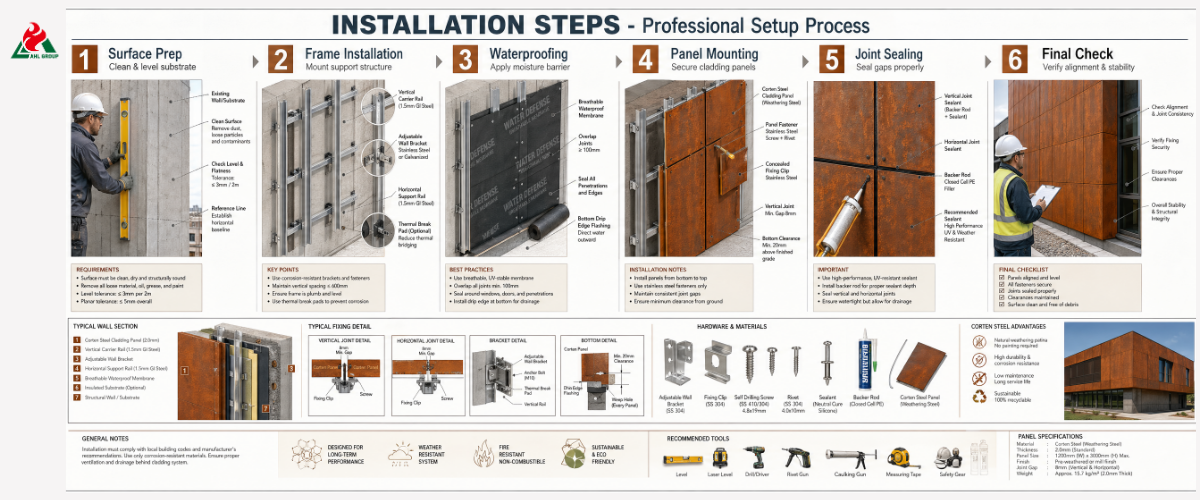
Although this material is extremely durable, it is not indestructible. Annual inspections are the “safeguard” that ensures the building’s 50-year lifespan.
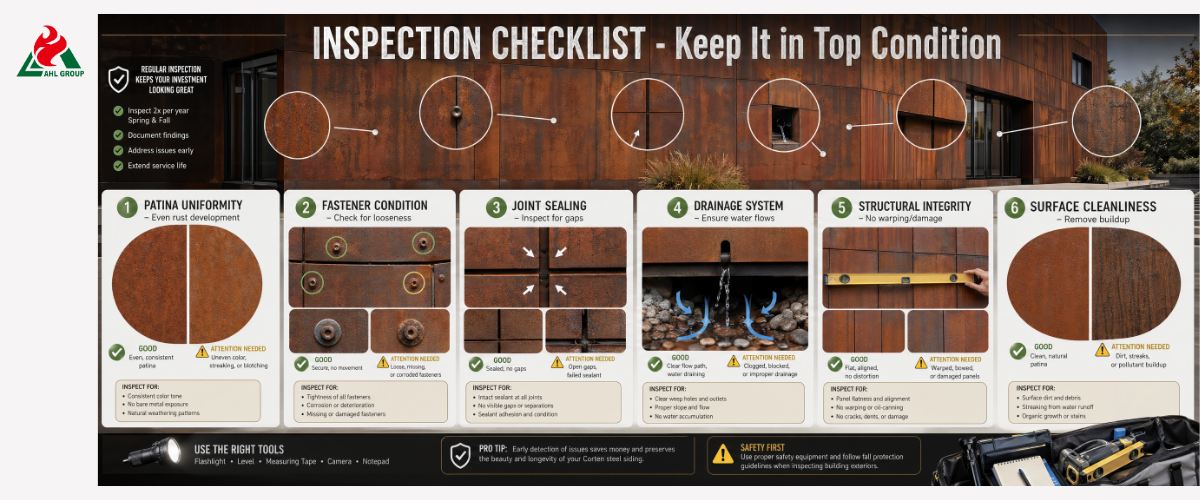
Inspect the Drainage System (No Standing Water)
The most critical task during the annual inspection is to verify the integrity of the drainage system. Corten steel exterior panels are typically installed as a rain screen, which means there is an air gap and a waterproofing membrane (WRB) behind the metal panels. This system relies on gravity and airflow to direct water away from the building. If the “drainage holes” at the bottom of the panels are blocked by dust, spider webs, or garden debris, rainwater will accumulate at the base of the steel.
Standing water is the “nemesis” of weathering steel. If the bottom edge of the panels is chronically submerged in standing water or damp soil, the protective rust layer will fail to form, and the steel will begin to “rot” from the bottom up. During inspections, use a small tool or blast compressed air to ensure that every drainage slot is completely unobstructed. This maintains the “wet-dry cycle,” prevents localized thinning of the metal, and ultimately safeguards the building’s airtightness.
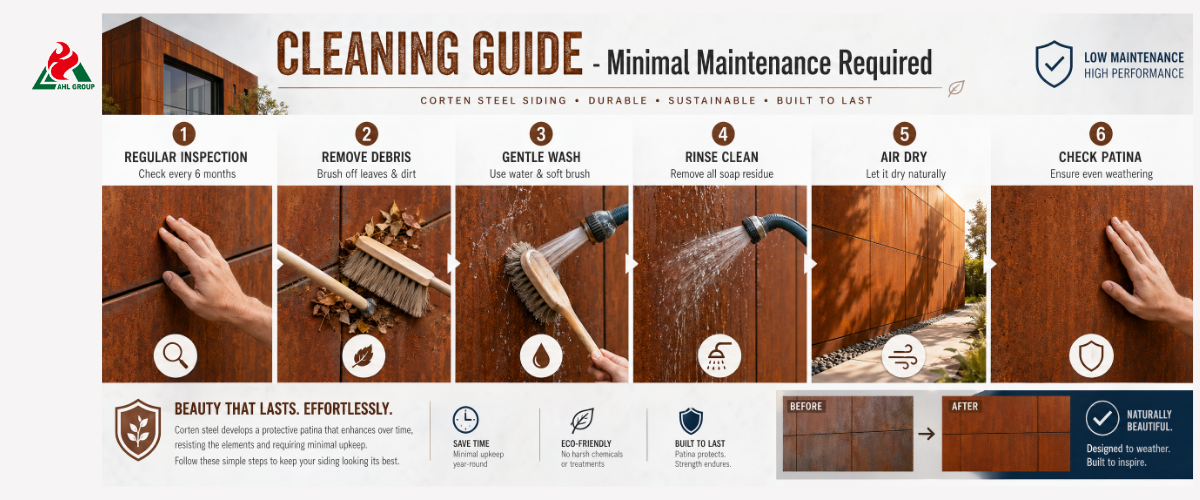
Hose Rinse (Remove Dirt/Bird Droppings)
Weathering steel is a material with “self-cleaning” properties; rainwater washes most dirt off its surface. However, in urban environments or areas with low rainfall, atmospheric pollutants (such as soot, sulfur, and salt) may accumulate on the surface. These pollutants are hygroscopic, meaning they absorb and trap moisture, causing it to remain on the surface of the rust layer. This can lead to uneven weathering or the formation of “white rust” (calcium deposits).
A simple low-pressure rinse with a garden hose once a year (preferably in the spring) is the best “cleaning agent” you can use. Pay special attention to bird droppings. Bird droppings are highly acidic and contain high concentrations of nitrogen and phosphorus, which can “corrode” the rust layer through chemical reactions. If bird droppings remain on the steel surface for an extended period under intense sunlight, they can leave permanent light-colored marks that disrupt the visual uniformity of the facade. Prompt rinsing removes these acidic substances, preventing them from reacting with the alloy and helping to maintain the rust layer’s deep, even color.
Check Fasteners and Seams (Loose = Water Entry)
Corten panels are typically secured with mechanical fasteners. Because metal expands and contracts with temperature changes (thermal expansion and contraction), fasteners may loosen after several seasons. During annual inspections, look for signs of “panel movement” or visible gaps at the seams. Loose panels not only generate noise but also allow moisture to penetrate the underlying structure, which can be difficult to dry out.
Additionally, it is essential to inspect the fasteners themselves for electrochemical corrosion. If installers used standard galvanized screws instead of stainless steel or fasteners compatible with weathering steel, the “more active” weathering steel will cause the “less active” screws to corrode rapidly. This can lead to catastrophic failure, causing panels to detach from the building. Ensure that each screw head is intact and that no reddish “active” rust is seeping from the fastener holes, as this is a primary indicator of poor metal compatibility.
4. NO, Skip These Common Mistakes
The most significant damage to Corten wall panels often stems from “over-maintenance”—well-intentioned but misguided use of traditional cleaning methods by property owners.
First, never use a pressure washer. While pressure washers are highly effective on concrete, they are disastrous for weathering steel. The high-velocity water stream physically strips away the stable, amorphous oxide layer on the steel’s surface, exposing the underlying “raw” silver metal. This forces the steel to restart its two-year weathering process in a patchy, uneven manner, resulting in a permanent “ghosting” effect on the building’s facade. Second, avoid using any abrasive agents. Using steel wool or wire brushes—especially those made of carbon steel—is a fatal mistake. These tools leave behind microscopic “foreign” iron particles that rust at a different rate than the steel itself, forming unsightly black pits and “pockmarks” on your beautiful weathering steel surface. Finally, do not use sealants unless specifically instructed by a building scientist. Most “anti-rust sealant” products are non-breathable; they trap moisture within the coating, leading to hidden and accelerated corrosion that can eat through the Corten steel panel within a fraction of its expected lifespan.
5. Maintenance By Environment: Adapting to Your Climate
The maintenance requirements for weathering steel are directly related to its geographical environment. In arid or desert climates, the real challenge is actually the lack of moisture. Without rain, a rust layer cannot form, and the steel may remain in its “original” state for years. Property owners in these regions typically “maintain” the steel by manually spraying it twice a week with a hose during the first few months to kickstart the oxidation process.
In coastal environments, the challenge lies in salt. Salt (chlorides) is the nemesis of a stable rust layer; it keeps the oxide layer “open” and porous, causing it to become excessively thin. In these areas, “maintenance” requires monthly rinsing with fresh water to wash away salt crystals before they penetrate the rust layer. Conversely, in heavily polluted industrial areas, the air may contain high concentrations of sulfur. This causes the rust layer to turn a very dark, nearly black color. Regular rinsing in these areas helps remove the acidic soot that darkens the metal, thereby preserving the warm “rust-brown” aesthetic preferred by most owners.
6. First 2 Years: Special Care Phase
Weathering steel structures are most “active” during the first 24 months of use and require the most attention. This is a transitional period during which the steel is forming its own “armor.”
Managing Orange Rainwater (Gutters and Downspouts)
During the “bleeding phase” (months 4 through 18), every heavy rainstorm will produce orange rainwater. This water is saturated with iron oxide particles that act like permanent dyes. If allowed to run down exterior walls and splash onto concrete sidewalks or white limestone plinths, it will leave dark rust stains that are nearly impossible to remove without strong acids.
Maintenance during this phase focuses on stormwater management. Ensure gutters remain clear and direct downspouts away from porous surfaces. Many professional installers use “temporary diverters” or plastic sheeting at the base of the building to catch runoff during the first two winters. By the end of the second year, the patina will have “set” (become insoluble in water), and the staining will cease almost entirely. This is merely a temporary maintenance burden; once this period passes, the issue will not recur.
Let Patina Develop Evenly (No Spot Cleaning)
For users who have recently purchased Corten steel products, the greatest temptation is to “clean” the mottled sheets. Perhaps one side of the building is more exposed to sunlight than the other, causing it to weather faster. Please resist the urge to intervene. The formation of rust is a marathon, not a sprint. If you try to scrub the “dark patches” to match the “light patches,” you will disrupt the alloy’s chemical bonding.
During the first two years, the most important “maintenance” you can provide is to let the steel develop naturally. Over time, as the chemical oxide layer reaches its maximum density, these mottled areas will gradually harmonize. A facade that appears “chaotic” at six months will, by the 36th month, present itself as a unified and harmonious architectural masterpiece. This requires a shift in mindset: you are not “cleaning” the building, but rather allowing it to “mature.”
Adjacent Surface Protection (Temporary)
Weathering steel does not exist in isolation; it is typically part of a combination of materials that includes glass, stone, and wood. During the initial “bleeding” phase, these adjacent materials are susceptible to staining. While glass is relatively easy to clean, porous stone readily absorbs iron oxide.
Professional maintenance measures include applying a sacrificial coating or a removable “liquid protective film” to nearby stone or concrete surfaces during the first two years. Alternatively, many modern designs incorporate a “gravel drainage trench” at the base of weathering steel walls. This gravel serves a dual purpose: it conceals the orange runoff seeping into the ground and prevents “splashback” (i.e., muddy water splashing up from the ground and contaminating the bottom of the steel panels). Managing the area surrounding the building is just as important as managing the steel itself.
7. Maintenance vs. Other Materials: A Comparative Study
In a life-cycle cost analysis (LCCA), weathering steel stands out as the most sustainable option in the long term. Traditional wooden siding requires cleaning and repainting every 3 to 5 years; if neglected, it will rot and must be replaced. Vinyl siding is prone to cracking and fading; although it requires less maintenance, its lifespan is limited to 20 years, after which it becomes brittle. While painted aluminum or metal siding may appear pristine, maintenance costs skyrocket once the paint is scratched or begins to “chalk” due to UV exposure, as professionally repainting a building’s exterior is a massive undertaking.
In contrast, weathering steel has an expected lifespan of 50 to 100 years and requires only occasional rinsing. Although maintenance is more intensive during the first two years due to the need to manage rainwater runoff, maintenance costs are virtually zero for the subsequent 48 years or more. This makes weathering steel the material of choice for infrastructure (bridges, shipping containers) and is increasingly favored in the commercial building sector, where “total life-cycle cost” is a key performance indicator (KPI).
| Material |
Painting Required? | Estimated Lifespan | Primary Maintenance Task |
| Corten Steel |
No | 50-100 Years | Debris clearing/rinsing |
| Wood Siding |
Yes (Stain/Paint) | 20-30 Years | Sanding, staining, and rot checks |
| Painted Steel |
No (until it peels) | 30-40 Years | Checking for scratches/rust |
| Fiber Cement |
Yes | 30-50 Years | Caulking seams and repainting |
8. Troubleshooting: Solving Common Issues
Even with the best maintenance, problems can still arise. If water from a landscape sprinkler system splashes onto exterior wall panels, white streaks often appear; this is because minerals (calcium) in the water leave behind “hard water” deposits. These can be removed by wiping with a 1:1 mixture of white vinegar and water. Black spots in shaded areas usually indicate algae or mold growth. While this does not damage the steel, it affects its appearance. These can be removed by rinsing with a mild, pH-neutral soap solution using a soft-bristle brush. Flaking or “sandy” rust is a more serious issue, indicating that the steel did not dry properly. If large areas of rust are flaking off, the rainscreen’s airflow or drainage system must be inspected immediately, as the steel is now in a state of corrosion rather than being protected.
Conclusion: Protecting Your Investment in Exterior Walls
Although 95% of weathering steel maintenance requires only visual inspection, certain signs indicate the need for intervention by a building envelope specialist. If warping or deformation of the panels is observed, it indicates that the thermal expansion joints have failed, which may lead to shear failure of the fasteners. If rainwater is found to be penetrating the building interior, it indicates that the rain screen system has been compromised. Finally, for large-scale commercial projects, a curtain wall consultant should be engaged every 10 years to perform “pull-out tests” on fasteners and measure steel thickness to ensure that the oxidation rate remains within predicted parameters.

