


Corten steel garden edging is becoming increasingly popular in residential landscapes, commercial gardens, and modern outdoor spaces because it combines durability, low maintenance, and a unique, natural appearance. Unlike traditional painted metal edging, Corten steel develops a weathered, rust-colored surface that becomes an integral part of the landscape design.
This material is particularly well-suited for settings that emphasize clean, simple lines. It creates a distinct transition between lawns and planting beds, outlines the contours of gravel paths, secures mulch, and distinguishes between different landscape materials—all without visually clashing with the plants.
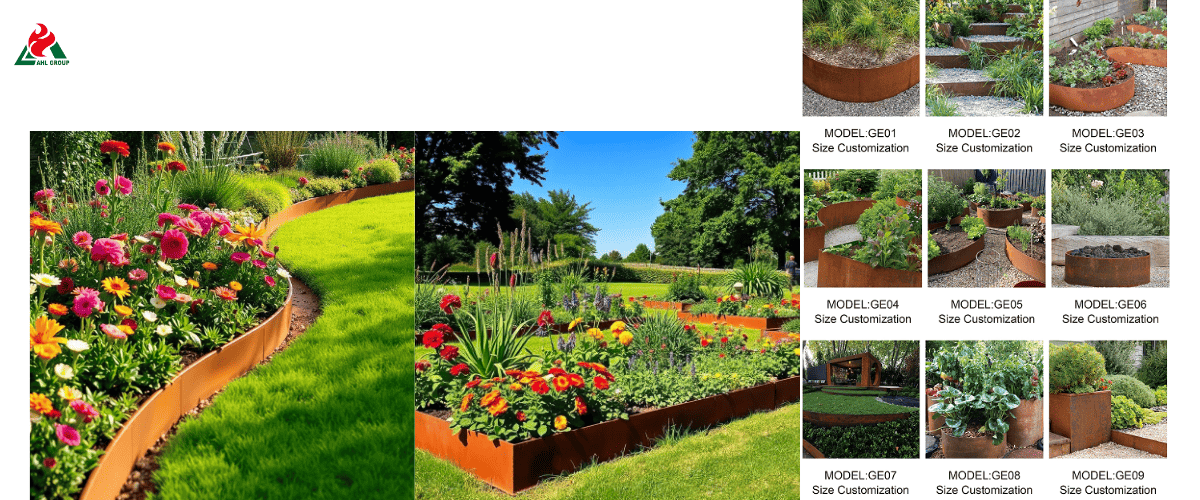
This material is particularly well-suited for settings that emphasize clean, simple lines. It creates a distinct transition between lawns and planting beds, outlines the contours of gravel paths, secures mulch, and distinguishes between different landscape materials—all without visually clashing with the plants.
1. Introduction
Why Corten Steel Is Becoming a Popular Choice for Garden Fences
Corten steel garden borders have quickly become the top choice among landscape designers, professional gardeners, and modern homeowners. Known for its unique warm orange and rich brown hues, this material perfectly blends raw industrial aesthetics with unmatched structural strength. Weathering steel does not fight against natural weathering outdoors; rather, it harnesses the elements to enhance its visual appeal while forming a protective barrier against structural deterioration.
The Difference Between Weathering Steel and Standard Steel Fences
Standard carbon steel fences quickly rust and flake when exposed to moisture and acidic substances in the soil, leading to a decline in structural integrity. Painted or galvanized steel alternatives, on the other hand, will peel, flake, or leach over time, requiring constant touch-ups or complete replacement. Weathering steel—also known as Corten steel—is alloyed by adding specific elements such as copper, chromium, nickel, and phosphorus. This chemical composition enables the metal to form a dense, protective oxide layer (patina) on its surface, thereby preventing deeper atmospheric corrosion.
Quick Answer: Is Corten Steel Suitable for Garden Edging
Yes, Corten steel is ideal for garden edging. It offers exceptional durability, long-term structural integrity, minimal maintenance requirements, and a clean, architectural aesthetic that clearly delineates lawns, gravel paths, and flower beds. Although the initial material cost is higher than that of plastic or thin aluminum edging, its decades-long lifespan makes it one of the most cost-effective landscaping investments in the long run.
This Guide Will Help You Make a Decision
This comprehensive guide explores in detail the technical specifications, wall thickness, interaction with soil, long-term durability, and installation methods for weathering steel edging. Please refer to this guide to assess whether weathering steel is suitable for your specific garden terrain, aesthetic goals, and project budget.
2. What Is Corten Steel Garden Edging
What Is Corten Steel
“Corten” is the registered trademark for weathering steel, a material originally developed for the heavy industry and transportation sectors. The name reflects its two primary characteristics: corrosion resistance (CORrosion) and tensile strength (TENsile). Today, general-purpose weathering steel produced in accordance with ASTM standards (such as ASTM A588 or ASTM A606 Type 4) has exactly the same metallurgical properties.
How the Protective Rust Layer Forms
When untreated Corten steel is exposed to alternating cycles of wet and dry weather, its surface oxidizes to form a textured outer layer. Within 6 to 18 months, copper, chromium, and nickel ions form an insoluble microcrystalline barrier. This rust layer seals the underlying metal, significantly slowing the rate of subsequent corrosion compared to ordinary steel.
Comparison of Weathering Steel and Ordinary Low-Carbon Steel
Unlike ordinary low-carbon steel, which continues to rust until the structure fails, the rust layer on weathering steel stabilizes once it is fully formed. While ordinary steel thins significantly within 3 to 5 years after coming into contact with damp ground, weathering steel maintains its structural stability for decades.
Common Weathering Steel Edging Profiles and Designs
► Flat Strip Edging: A flexible, continuous steel strip that is ideal for outlining the curves of lawn borders and path edges.
► L-Shaped Profiles: Featuring a wide flange at the bottom, these provide excellent stability when installed on concrete foundations or hardscaped surfaces.
► Corrugated or Textured Edging: Adds visual depth to retaining walls and provides additional lateral strength.
► Precast Curved Panels: Sturdy, precision-bent components that create smooth, repeatable circular tree rings or geometric flower beds.
Common Applications of Weathering Steel Edging
Corten steel edging is widely used in high-end residential gardens, public parks, commercial plazas, wineries, and urban rooftop terraces. It performs particularly well when creating clear boundaries between gravel paths, decorative stone coverings, lawns, and flower beds.
3. Is Corten Steel Good for Garden Edging
Exceptional Durability, Ideal for Long-Term Landscaping Projects
Weathering steel garden edging can withstand heavy impact from foot traffic, gardening tools, and seasonal freeze-thaw cycles without cracking, warping, or breaking under stress, unlike plastic edging.
Natural Patina, Minimal Maintenance
Once installed, weathering steel requires virtually no ongoing maintenance. It never needs to be painted, chemically sealed, or treated with rust-preventive coatings. Whenever minor scratches appear on the surface, the natural rust patina continuously self-repairs.
Exceptional Outdoor Weather Resistance
Whether facing scorching heat, torrential rain, or sub-zero cold, weathering steel maintains its structural stability and original geometric contours year after year.
Clear Demarcation Between Lawns, Flower Beds, and Pathways
Corten metal edging serves as a sturdy barrier against root intrusion and material spread. Its slim profile cuts precisely into the soil, preventing lawn grass roots from invading flower beds while securely enclosing gravel pathways.
Why Weathering Steel Is Suitable for Modern and Natural-Style Gardens
Once weathered, weathering steel takes on a rustic, warm orange hue that complements a wide range of design styles—from clean-lined, ultra-modern minimalist hardscapes to soft, natural woodland aesthetics—blending seamlessly with them all.
When to Avoid Weathering Steel Edging
In certain environments, installing weathering steel may require special consideration:
► High-salinity coastal areas: Direct and intense sea spray can damage the protective rust layer and accelerate corrosion.
► Soil subject to prolonged waterlogging: Weathering steel requires cycles of drying and wetting; persistent standing water hinders the stable formation of the protective oxide layer.
► Adjacent to light-colored marble or stucco walls: During the initial weathering phase of 6 to 12 months, rust from surface runoff may seep out, leaving rust stains on light-colored concrete pavers or walls.
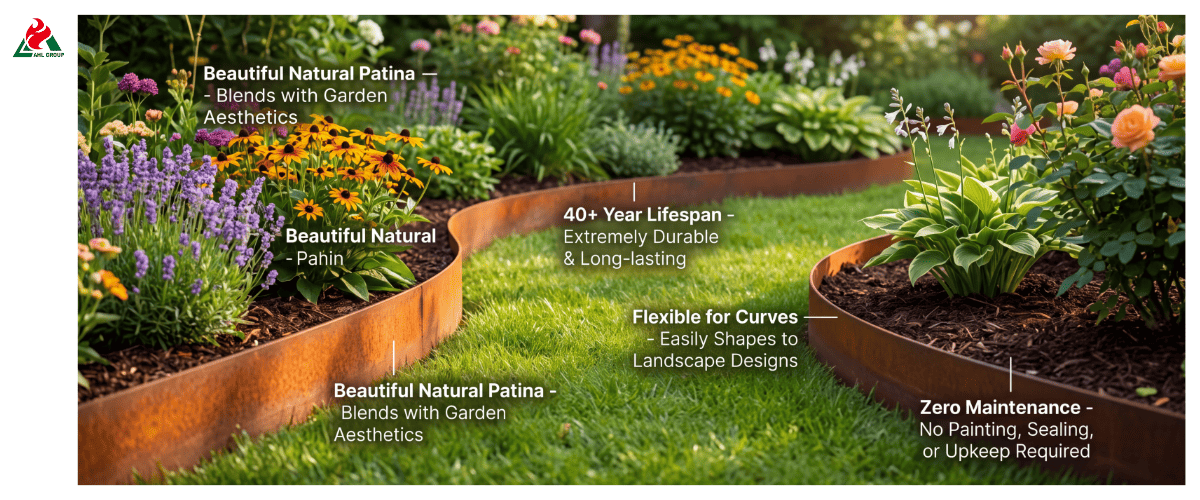
4. Key Benefits of Corten Steel Garden Edging
Longer Service Life Compared to Painted Steel
Painted steel begins to rust within months of the paint peeling at the edges, whereas high-quality weathering steel (Corten steel) typically has a service life of 25 to 40 years or more when used outdoors, depending on thickness and soil conditions.
Low-Maintenance Landscaping Solution
No more seasonal painting, sanding, or chemical sealing is required. Weathering steel naturally resists weathering, thereby reducing the maintenance workload for landscape managers and property owners.
A Captivating Rust-Brown Appearance
Over time, the vibrant rust patina transitions from bright orange and warm rust tones to a deep chocolate brown, creating a visual highlight that grows more profound with the passage of time.
Sturdy and Rigid Garden Edging
Weathering steel has high tensile strength, allowing it to maintain straight, clean structural lines even when subjected to soil movement, gardening equipment, and frequent foot traffic.
Excellent Shape Retention
Unlike plastic edging, which can warp into a wavy shape when exposed to summer heat, Corten edging lawn remains straight over long stretches and maintains smooth, neat curves along curved boundaries.
Compatibility with Mulch, Gravel, Stone, and Plants
Once stabilized, weathering steel is chemically inert. It does not leach harmful synthetic chemicals, microplastics, or toxins into the surrounding garden soil, making it completely safe for adjacent plants and soil organisms.
Recycling Potential at the End of Its Service Life
Weathering steel is 100% recyclable. At the end of its long service life, it can be melted down and reused, thereby supporting sustainable construction and circular landscape design practices.
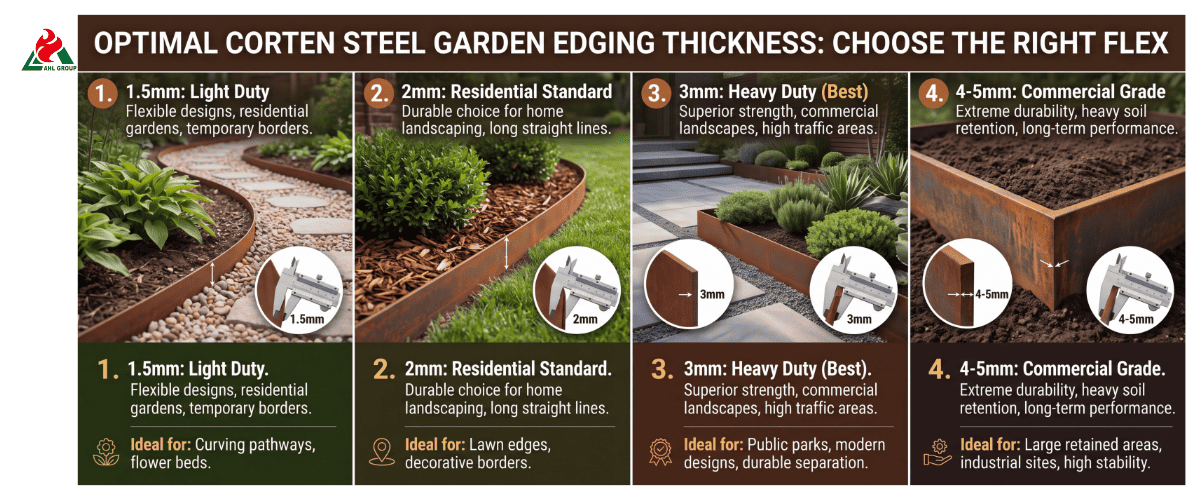
5. Corten Edging Thickness: What Is Best
Choosing the right steel thickness is key to achieving the ideal balance between structural rigidity, flexibility, and service life.
1.5–2 mm Corten Steel Edging, suitable for light-duty residential projects
► Best suited for: Gentle flower bed borders, short decorative garden dividers, and compact curves.
► Features: Easily bent by hand; lightweight and cost-effective; best suited for light-duty garden borders that do not endure heavy foot traffic.
2–3 mm, Designed for Standard Garden Edging
► Best suited for: Typical residential lawns, gravel paths, and raised flower bed borders.
► Features: The industry standard for high-quality landscape design. Easily maintains straight lines while smoothly bending into elegant curves.
3–4 mm, Designed for Heavy-Duty Landscape Applications
► Best suited for: Public parks, heavy-duty gravel driveways, retaining flower beds, and commercial development projects.
► Features: Exceptional structural strength. Withstands severe impacts from ride-on mowers, lawn tractors, and heavy foot traffic.
4–6 mm, Designed for Commercial and High-Impact Projects
► Best suited for: Retaining walls, terraced hillside flower beds, urban plazas, and high-impact public spaces.
► Features: High load-bearing capacity and exceptional durability, capable of withstanding vandalism or vibrations from heavy vehicles.
How Thickness Affects Stiffness and Service Life
Thicker steel directly increases mechanical stiffness and extends overall service life. Since atmospheric weathering erodes a small amount of metal every decade, increasing the steel thickness from 1.5 millimeters to 3 millimeters can effectively double the structural service life of the material in underground environments.
How to Select Thickness Based on Retaining Wall Height and Soil Conditions
Please use this recommendation matrix to select the appropriate thickness based on your project parameters:
| Edging Application | Recommended Height | Ideal Steel Thickness | Flexibility Level |
| Simple Lawn Divider | 4 in (100 mm) | 1.5 mm – 2.0 mm | High (Easy to shape) |
| Standard Bed & Pathway | 6 in (150 mm) | 2.0 mm – 3.0 mm | Moderate (Smooth curves) |
| Driveway / Heavy Gravel | 6 in – 8 in (150–200 mm) | 3.0 mm – 4.0 mm | Low (Requires pre-bending) |
| Retaining Bed / Terrace | 8 in – 12 in (200–300 mm) | 4.0 mm – 6.0 mm | Rigid (Requires welded joints) |
6. How Long Does Corten Garden Edging Last
Typical Service Life of Weathering Steel Borders
Under standard residential landscaping conditions, high-quality Corten landscape edging has a service life ranging from 25 to 50 years. In well-drained soil with moderate moisture levels, high-quality 3-millimeter weathering steel can easily last more than 45 years.
Factors Affecting the Service Life of Weathering Steel Borders
► Soil Moisture and Acidity: Persistently damp, highly acidic peat soil accelerates metal corrosion.
► Exposure to Atmospheric Salinity: Marine aerosol environments accelerate the flaking of the rust layer.
► Physical Wear: Direct mechanical scraping caused by lawnmower blades subjects the exposed metal to repeated cycles of rusting.
The Impact of Soil Moisture and Drainage
For weathering steel to form a stable rust layer underground, the surrounding soil must have good drainage. Backfilling with crushed gravel or coarse sand helps extend the service life of the metal buried underground.
Coastal and High-Salinity Environments
Within 1 mile of the coastline, high concentrations of airborne salt can hinder the formation of a dense, protective rust layer, leading to accelerated flaking of the Corten steel rust layer. For coastal applications, it is recommended to select thicker gauges (e.g., 3 mm or 4 mm).
Why Proper Installation Is Critical for Long-Term Durability
Installing curbs on a compacted gravel drainage layer prevents long-term water accumulation around the buried base, thereby maximizing the service life of the installed structure.
7. Corten Steel Edging vs Other Materials
Weathering Steel vs. Galvanized Steel Frames
Galvanized steel relies on a zinc coating on its surface to prevent rust. Although it is durable, once the thin zinc layer is scratched through by a lawn mower or a stone, the underlying metal will rust rapidly. In contrast, weathering steel has self-healing properties throughout its entire thickness.
Weathering Steel vs. Painted Steel Frames
When exposed to UV rays, painted steel will show signs of paint peeling and fading within just a few seasons, leading to rapid corrosion of the exposed steel. Weathering steel requires no surface coating, and its appearance actually improves over time.
Weathering Steel vs. Aluminum Frames
Aluminum is lightweight, flexible, and completely rust-free. However, it lacks the high tensile strength, structural rigidity, and warm, natural aesthetic appeal of weathering steel.
Weathering Steel vs. Plastic and Composite Frames
Plastic frames are inexpensive and easy to install, but they are prone to cracking in cold winter weather, warping under the intense summer sun, and aging from prolonged sun exposure, requiring frequent replacement.
Weathering Steel vs. Stone and Concrete Edging
Concrete and natural stone can form extremely durable edging, but they require digging wide trenches, applying mortar, and significant labor. Weathering steel, on the other hand, offers clean, simple lines and takes up far less ground space than these materials.
Weathering Steel vs. Wooden Garden Edging
Wooden landscape timbers are prone to rotting, cracking, and attracting termites, and over time they absorb moisture from the soil—even when pressure-treated with preservatives. Weathering steel not only has a longer service life but also offers a slimmer, cleaner-looking edging profile.
Which Garden Border Material Is the Most Durable
Aside from solid granite or stone masonry, Corten steel (3 mm and thicker) is one of the most durable landscape border materials on the market today.
8. Design and Appearance of Corten Garden Edging
Changes in Rust Over Time
► Days 1–30: Original deep gray metallic appearance.
► Months 1–3: A bright orange, slightly powdery layer of rust forms.
► Months 3–12: The rust transforms into a deep, warm amber-brown color.
► From the 2nd year onward: The rust stabilizes, forming a rich, deep chocolate-brown protective layer.
The Difference Between Orange-Brown and Deep Rust-Brown Finishes
In dry climates, the rust retains a lighter orange-brown hue, whereas in rainy, humid climates, weathering steel transforms more rapidly into deeper, darker brown tones.
Straight Weathering Steel Edging for Modern Landscape Design
In contemporary landscape architecture, 3-millimeter or 4-millimeter-thick rigid weathering steel sheets can be used to create laser-straight lines, geometric flower beds, and sharp right angles.
Curved Corten Steel Edging for Natural-Style Garden Design
Thinner, flexible Corten steel borders—ranging from 1.5 mm to 2 mm in thickness—allow landscape designers to hand-bend smooth, flowing curves that encircle trees, wind along paths, and frame natural flower beds.
Corten Steel Edging Paired with Gravel and Stone
The rich rust patina of Corten steel contrasts sharply with light-colored decorative aggregates, gray granite chippings, white river stones, and slate coverings.
Combining Weathering Steel with Wood and Concrete
Pairing Corten garden edging with cast-in-place concrete walkways, slate pavers, or warm, textured natural cedar decking creates a refined look where natural textures complement one another.
Using Weathering Steel Edging as a Landscape Design Highlight
Instead of hiding the edging flush with the ground, allow 1 to 2 inches of weathering steel to protrude above the surface, creating a striking architectural accent line.
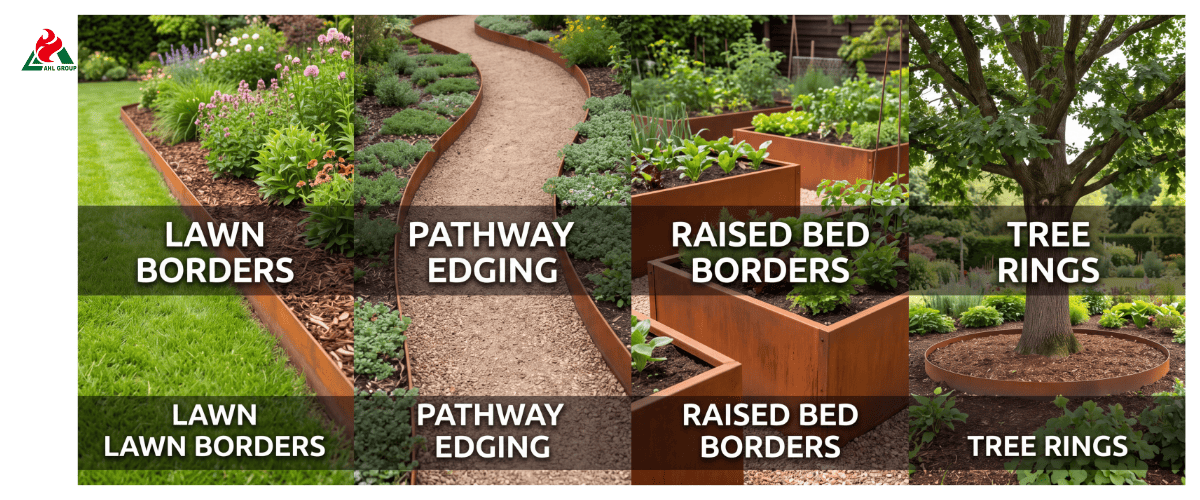
9. Corten Edging for Different Garden Applications
Lawn and Flower Bed Boundaries
Prevents fast-growing grass species, such as Bermuda grass or Kenyan grass, from sending stolons into artificial flower beds, thereby maintaining a permanent boundary.
Gravel and Decorative Stone Paths
Secures loose pea gravel, crushed stone, or weathered granite within the path boundaries, preventing it from shifting onto adjacent lawns.
Driveways and Sidewalks
Heavy-duty Corten edging, 3 to 5 millimeters thick, can withstand the pressure of vehicle tires at the edge of a driveway, providing a sturdy boundary for gravel or asphalt surfaces.
Raised Planters
Weathering steel panels 8 to 12 inches thick can be used to create eye-catching raised vegetable and flower planters that maintain their structural shape without bending, even under the weight of heavy soil.
Vegetable and Herb Gardens
Weathering steel is completely safe for edible gardens. Its stable oxide layer prevents synthetic polymers or toxic chemicals from leaching into the planting soil.
Sloped Gardens and Terraces
By securely holding soil in place on terraced slopes, it helps control soil erosion.
Commercial Landscapes and Public Spaces
Weathering steel edging requires minimal maintenance and offers high resistance to structural impact, making it ideal for high-traffic public parks and commercial developments.
Modern Residential Gardens
Its clean, horizontal lines define the contours of modern residential landscapes.
10. How to Install Corten Steel Garden Edging
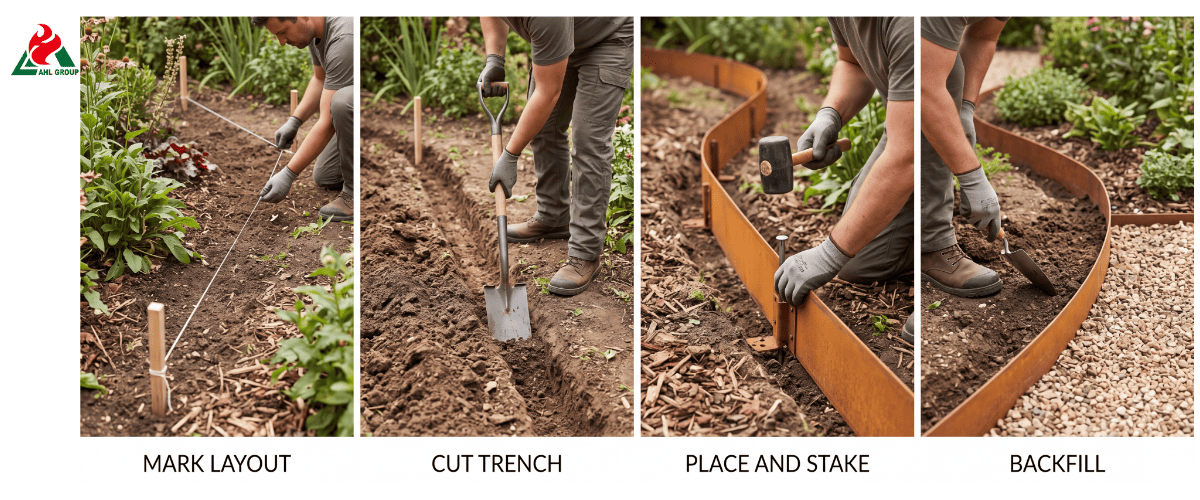
1. Plan the Boundary Layout
Mark the path with string or spray paint.
Use chalk lines, string, or landscape spray paint to outline the proposed boundary. Carefully check all curves and right angles before cutting the grooves.
2. Measure the Total Perimeter
Be sure to account for the length of the overlapping joints.
Measure the total length. Add 5% to the total length when placing your order to account for overlapping joints and cutting waste.
3. Selecting Straight and Flexible Sections
Choose the appropriate edging profiles.
For long, straight sections, order 3-millimeter-thick rigid metal edging; for winding garden borders, use 1.5–2-millimeter-thick flexible steel edging.
4. Trench Preparation and Excavation
Use a flat-bladed trenching shovel to dig a narrow trench.
Dig a narrow trench along the planned line. Ensure the trench bottom is level and free of large rocks or thick tree roots.
5. Recommended Installation Depth
Bury 50% to 70% of the total height of the edging strip underground.
For a standard 6-inch (150 mm) high edging strip, bury 3 to 4 inches (75–100 mm) underground, leaving 1.5 to 2 inches exposed above the final ground level.
6. Properly Position the Edging
Align the steel edging and place it in the trench.
Position the durable steel edging vertically in the trench, and use a level to ensure the top edge remains level and vertical.
7. Connecting Multiple Frame Sections
Secure the panels together using the fasteners provided by the manufacturer.
Use the manufacturer’s flush-mounting clips, stainless steel bolts, or specialized joining plates to lock the overlapping ends together.
8. Installing Anchor Posts and Ground Pegs
Drive anchor posts into the ground to secure the frame in place.
Drive Corten steel or heavy-duty composite ground stakes into the ground every 3 to 5 feet along the back of the edging to prevent the edging from loosening as the soil shifts.
9. Backfill and Compact the Soil
Fill the trench with backfill material and compact it firmly.
Backfill a layer of soil, coarse sand, or pea gravel on both sides of the trench and compact it firmly to secure the steel strips in place.
10. Check Final Alignment and Levelness
Verify straightness and curve symmetry
Step back a few paces to visually inspect the lines. Before performing the final turf backfill, use a rubber mallet to make fine adjustments to ensure accurate height.
11. Can Corten Edging Be Bent for Curves
Can 2–3 mm Thick Weathering Steel Edge Be Bent by Hand
Yes. Standard 2 mm thick weathering steel landscape edging can be easily bent by hand on-site into wide-radius curves. 3 mm thick steel can also be bent by hand into wide-radius curves, but a lever tool is required to bend it into tight-radius curves.
Recommended Bending Radii for Weathering Steel Border
► 1.5 mm thickness: Minimum bending radius is approximately 20 inches (500 mm).
► 2.0 mm thickness: Minimum bending radius is approximately 36 inches (900 mm).
► 3.0 mm thickness: Minimum bending radius is approximately 60 inches (1,500 mm).
Creating Gentle Landscape Curves
To create smooth, natural curves, lay the steel strip flat on the lawn, place your feet near the center, and pull both ends upward evenly to form a gradual curve before placing it in the trench.
Using Tools to Create Tighter Curves
For sharp or tight curves, clamp the weathering steel strip between two thick wooden blocks and use a rubber mallet or bending rod to form an even curve.
When to Choose Factory-Pre-bent Edging Strips
If you need to create precise 90-degree inside or outside corners, tight circular tree rings, or geometrically complex planters, choose factory-laser-cut and pre-bent corner pieces to ensure a clean and attractive installation.
How to Avoid Creases and Stress Cracks
Never attempt to bend 3-millimeter or thicker steel to a sharp 90-degree angle without heating it first. Unless proper notching is performed or specialized mechanical bending tools are used, unsightly structural creases may form along the top edge.
12. Maintenance Requirements
Do Corten Gardens Edging Need to Be Painted
No. Corten steel must never be painted. Painting defeats its primary purpose, as the paint will eventually crack, causing moisture to become trapped beneath the paint layer and leading to localized corrosion.
Do Corten Steel Edging Need to Be Sealed
Generally, Corten steel does not need to be sealed. Although a clear chemical sealant can temporarily prevent early rust from spreading to nearby white pavers, the sealant blocks the steel’s natural exposure to the atmosphere and must be reapplied every 2 to 3 years.
Cleaning Dirt, Fallen Leaves, and Debris
Regularly rake away damp autumn leaves and heavy soil from the top edges to maintain airflow and allow the steel to complete its natural cycle of rusting through alternating wet and dry conditions.
Inspect Ground Anchors and Joints
Each winter, after the cold weather has caused frost heave, inspect the ground anchors and the connecting screws at the joints to ensure that each section remains securely fastened.
Manage Excess Moisture
Ensure that adjacent flower beds do not experience prolonged water pooling. Laying a gravel base beneath the boundary line helps facilitate drainage around the steel bases buried underground.
Monitor for Abnormal Corrosion
If deep flaking or pitting appears in localized areas, check for corrosive chemicals, fertilizer leaks, or accumulated brine. Brush away loose rust with a wire brush and allow the fresh metal to re-oxidize naturally.
How to Maintain a Natural Patina
Let nature take its course. The alternating effects of sunlight and natural rainfall will automatically form a stable, protective patina over time.
13. How to Choose the Right Corten Garden Edging
Determine the Required Edging Height
Measure the total depth of the trench plus the desired height above ground level. Standard garden lawn edging typically requires a total height of 4 to 6 inches (100–150 millimeters).
Select the Appropriate Steel Thickness
For elegantly shaped curved flower beds, choose 1.5–2 millimeters; for standard residential lawn edging, choose 2–3 millimeters; for high-traffic driveways or commercial areas, choose 3–4 millimeters or thicker.
Choose Straight or Curved Profiles
Purchase rigid straight profiles for straight paths, and flexible, ribless profiles for winding lawn edging.
Verify Weathering Steel Grades
Ensure the supplier clearly specifies authentic weathering steel standards, such as Corten A/B, ASTM A588, ASTM A606-4, or S355J2WP. Avoid purchasing unalloyed low-carbon steel sold under the generic term “weathering steel.”
Review Connection and Anchoring Systems
Choose an edging system equipped with concealed internal connectors, pre-drilled dowel slots, and stainless steel assembly hardware to ensure quick and secure installation.
Check Drainage and Edge Finishing
Ensure the top edge is rolled, folded, or smoothly deburred to eliminate sharp edges and protect pets and people walking barefoot.
Confirm Dimensions and Tolerances
Before placing an order for a large-scale landscaping project, please verify the panel lengths, profile heights, and thickness tolerances.
Request Technical Specifications from the Supplier
Please request official metallurgical test certificates or material data sheets from the supplier to verify the actual alloy composition.
14. Frequently Asked Questions
Q1: How Long Does Weathering Steel Garden Edging Last?
High-quality weathering steel garden edging, 2 to 3 millimeters thick, typically lasts 25 to 50 years in normal outdoor soil conditions—decades longer than wood, plastic, or painted steel edging.
Q2: What Is the Optimal Thickness for Weathering Steel Garden Edging?
For most residential landscaping applications, a thickness of 2 to 3 millimeters strikes an ideal balance between structural strength, ease of installation, and service life.
Q3: Can Corten Steel Garden Edging Be Bent?
Yes. Corten steel edging with a thickness of 1.5 to 2 millimeters can be easily bent by hand into smooth, natural curves. Thicker 3-millimeter steel strips can also be bent into wide arcs during installation.
Q4: Do Corten Steel Borders Need to Be Painted or Sealed?
No. Corten steel relies on its natural rust patina to provide corrosion protection, so it should be left in its natural state without painting or sealing.
Q5: Are Corten Steel Borders Safe for Vegetable Gardens?
Yes. Corten steel is completely safe for organic vegetable and herb garden beds. Its stable iron oxide surface does not leach harmful synthetic chemicals into the surrounding soil.
Q6: How Deep Should Weathering Steel Garden Edging Be Buried in the Ground?
Generally, 50% to 70% of the edging’s total height should be buried underground. For standard 6-inch-high edging boards, they should be buried 3 to 4 inches deep in the soil.
Q7: Can Corten Edging Be Installed Around Trees?
Yes. Flexible Corten edging or pre-bent circular sections make ideal tree rings, both securing mulch and protecting the base of the tree trunk from damage caused by lawn mowers.
Conclusion: When Choosing Corten Steel Edging Offers the Best Long-Term Value
For any landscaping project where long-term durability, zero ongoing maintenance, and refined architectural aesthetics are top priorities, Corten outdoor garden edging offers exceptional value. Although the initial material cost is higher than that of plastic or wood options, its service life spanning decades eliminates the costs of repeated replacements and repairs.
For standard residential landscape flower beds and gravel paths, we recommend weathering steel with a thickness of 2 to 3 millimeters and an embedded ground-stake anchoring system. Ensure that drainage channels remain unobstructed, maintain a burial depth of 3 to 4 inches, and let the natural weathering process transform your garden borders into enduring architectural landscape elements.

